How to optimize a mature Klaviyo account

When most brands think about email marketing optimization, they immediately look at open and click rates. And while these metrics certainly matter, they often stop being the biggest growth opportunity once an account reaches a certain level of maturity.
This was exactly the challenge faced by Agradi. With more than 20 active flows, multiple markets, a loyalty program, and several campaigns sent every week, their Klaviyo setup was already performing well. The question was no longer "How do we get email marketing working?" but rather "Where do we find the next 10-20% improvement?"
The answer lies in looking beyond surface-level metrics and examining the customer experience behind them.

1. Hidden account fatigue
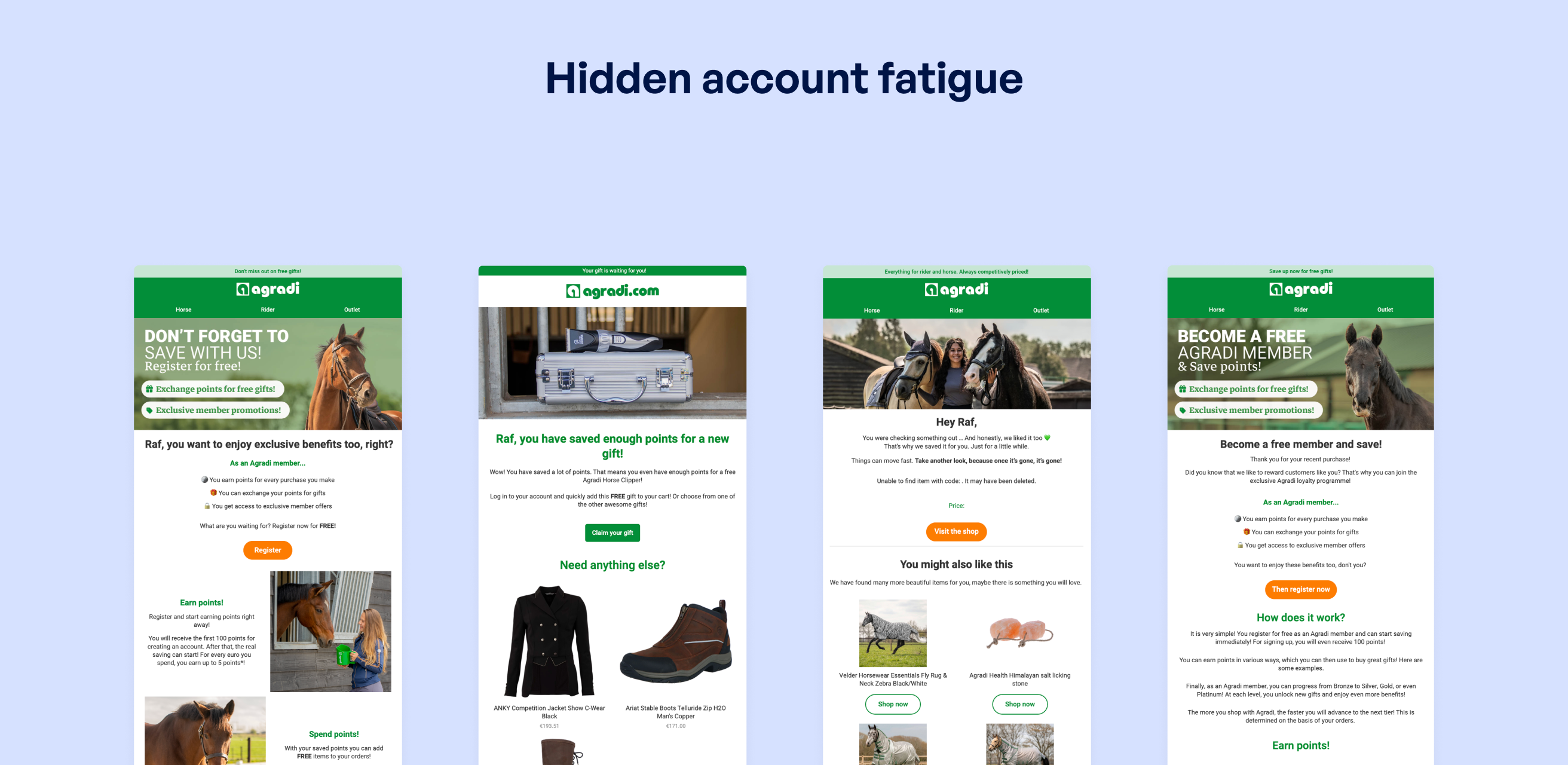
A mature account can continue generating strong revenue while gradually exhausting its audience. Open rates may remain stable, campaigns may still convert, and yet subscribers become less engaged over time because every email starts to feel the same.
This was particularly relevant for Agradi. As a promotion-heavy brand, discounts and offers are a major part of their success. Customers are trained to look for deals, which drives strong short-term performance, not genuine intentional engagement with the brand.
Sometimes the next growth opportunity isn't sending more promotional emails, it's creating reasons for customers to stay engaged between promotions with value-driven and personalized content.
2. Email overload: Mapping the real customer experience
Most brands know how many campaigns they send. Far fewer know how many emails their different types of customers actually receive.
When we mapped the customer journey, we discovered that highly engaged customers could be receiving emails from multiple directions at the same time:
- Weekly campaigns
- Loyalty communications
- Transactional emails
- Automated flows
Individually, every email made sense. Together, the experience could become overwhelming.
For mature accounts, optimization often means reducing unnecessary communication rather than adding more. The goal is not to send fewer emails across the board, but to identify overlaps and redundancies.
In many cases, removing a small number of low-impact emails can significantly improve the overall customer experience while maintaining revenue.
3. Strategic A/B testing
Many email programs run A/B tests, but most focus on small tactical changes: subject lines, send times or button colors. However, mature accounts often benefit more from strategic testing.
One example we explored with Agradi was campaign structure. Because Agradi offers a large assortment of equestrian brands and products, campaigns often featured eight or more products in a single email.
The assumption was simple: more products create more opportunities for customers to find something relevant.
A focused email often creates a clearer narrative, stronger visual hierarchy, and a more obvious call to action. Too many products can dilute attention and reduce click-through rates.
Other strategic tests may include:
- Educational versus promotional content
- Brand-focused versus category-focused campaigns
- Product recommendations versus editorial content
- Single CTA versus multiple CTAs
The larger the account becomes, the more important it is to test assumptions rather than simply optimize details.

4. Introduce lifecycle marketing
Different customer types often entered the same flows and received similar messaging despite having very different relationships with the brand.
Agradi already had a successful loyalty program in place. However, many lifecycle communications remained relatively generic. A customer who places their first order should not be treated the same as someone who has spent thousands of euros over multiple years.
This is where lifecycle marketing becomes critical, each group has different motivations and expectations.
Think about:
- First-time buyers
- Repeat purchasers
- Category enthusiasts
- Loyalty members
- High-value customers
- At-risk customers
One area many brands overlook is their VIP strategy. Agradi already had a strong loyalty program, but a VIP experience should go beyond simply providing points or sending the same newsletter slightly earlier. The strongest VIP programs combine loyalty benefits with tailored email experiences that create genuine exclusivity.
5. Merchandise smarter
One of the most overlooked optimization opportunities in mature Klaviyo accounts is merchandising analysis.
Instead of building campaigns around what's new or what's available, brands can prioritize hero products that drive long-term customer value.
Marketing analytics can uncover patterns that are not immediately visible in sales reports. For example, a product category with moderate revenue may actually create the strongest repeat-purchase behavior. Another category may consistently attract discount-dependent shoppers, reducing long-term profitability.
These insights can then be translated directly into email strategy:
- Build replenishment flows around repeat-purchase products
- Feature hero categories more prominently in campaigns
- Create bundles around high-margin combinations
- Develop category-specific lifecycle journeys
Conclusion
For mature Klaviyo accounts, growth rarely comes from adding another flow or sending another campaign.
The biggest opportunities often come from stepping back and evaluating the entire customer experience.
That means identifying hidden fatigue, reducing unnecessary email volume, testing bigger strategic ideas, creating differentiated customer journeys, and using merchandising insights to make smarter decisions.
For Agradi, the challenge wasn't building an email marketing program from scratch. It was finding the next level of performance within an already successful setup. And that's where true email marketing optimization begins.